
Food Forest and Garden
Why I planted tagasaste before a single fruit tree
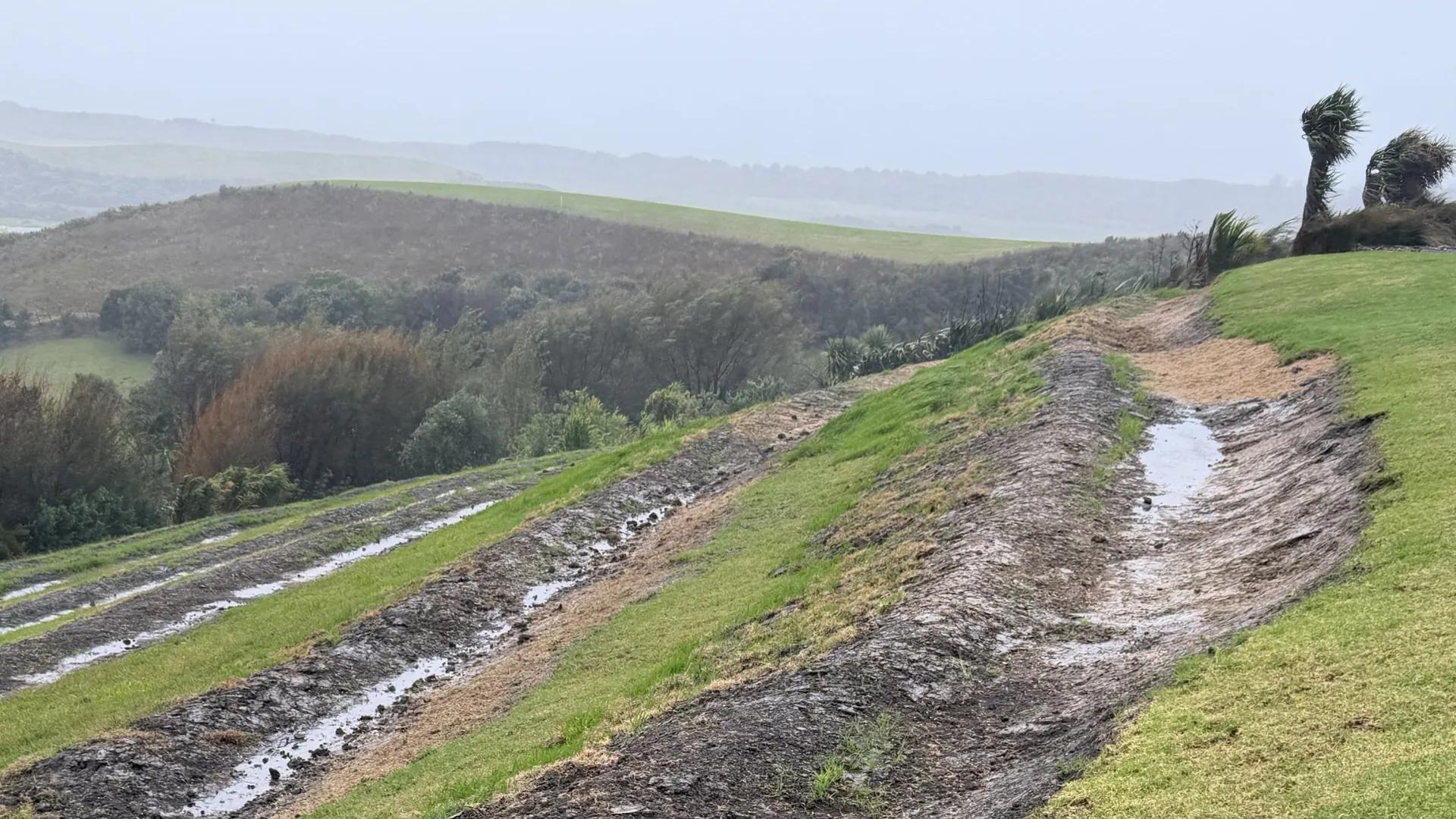
Push a spade into our hillside at Whangārei Heads and at about 150 mm you hit clay. It is stiff and grey, mottled orange and brown, and it runs down at least three metres.
I want a syntropic food forest on that hillside. A fruit tree planted straight into it gets clay underneath, kikuyu all around, and a north-easterly off the Pacific over the top.
So the fruit trees wait. Something tougher goes in first and changes the conditions for them. That is the job of a pioneer species.
I plant three pioneers together, and the layout is in Rebuilding soil on a clay hillside. The one I lean on hardest is tagasaste (tree lucerne).
I have raised a couple of hundred from seed. They go along the top of each swale berm, one metre apart.
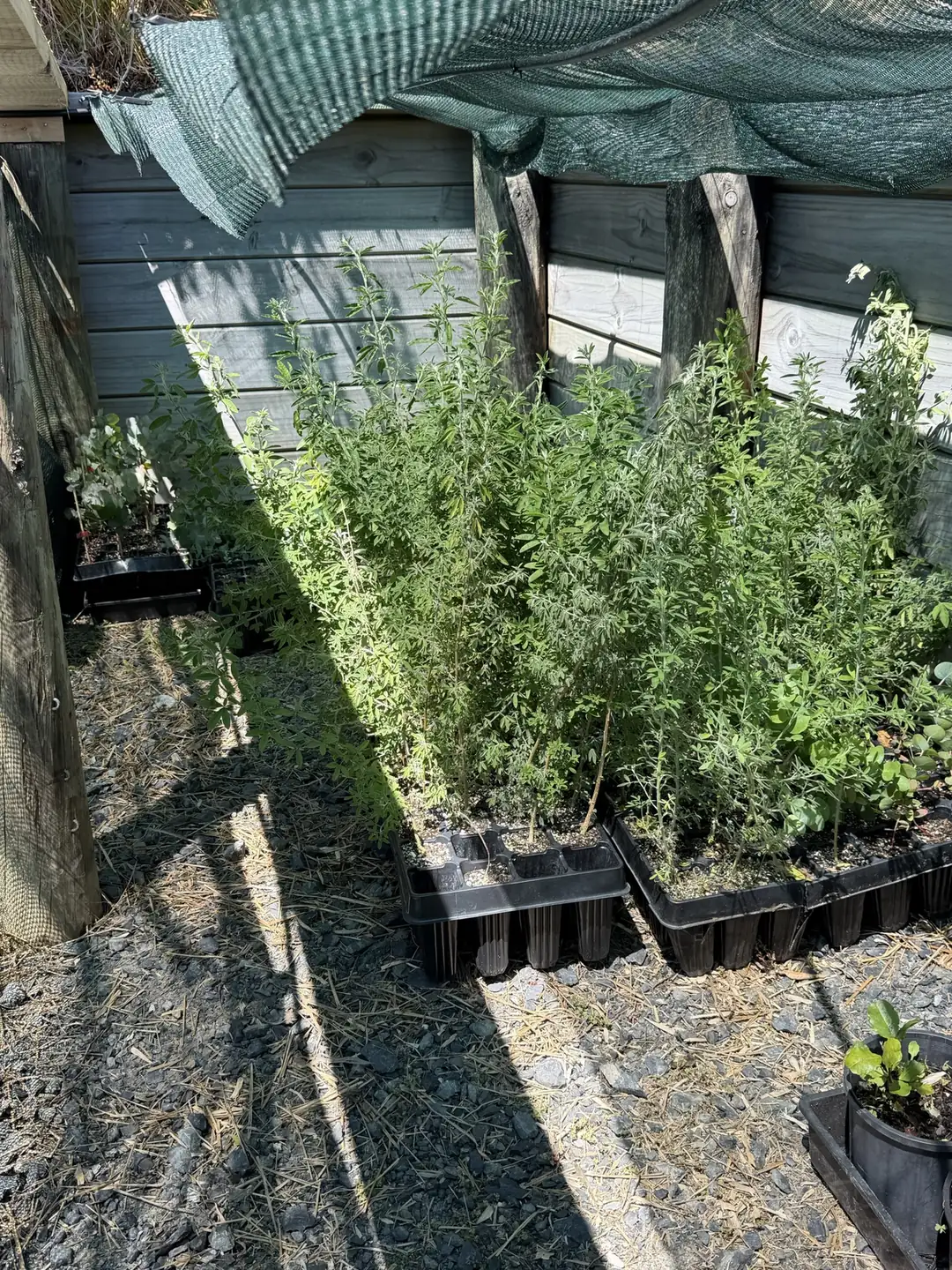
Pioneer species
On this site a pioneer has to:
- put nitrogen into ground that has been stripped of it
- grow fast enough to make shelter in a couple of years
- stand up to salt wind and a dry summer
- feed something while it grows
- get out of the way when the job is done
Tagasaste does every one of those.
Nitrogen
Tagasaste is a legume. Bacteria in its root nodules take nitrogen from the air and fix it in a form plants can use.
In Western Australia, trees planted in alleys fixed 83 kg of nitrogen per hectare a year at 550 trees per hectare, and 390 kg at 2,330 trees per hectare. That works out at about 0.16 kg of nitrogen per tree, per year.
A hedge at one metre spacing puts that along the full length of a berm.
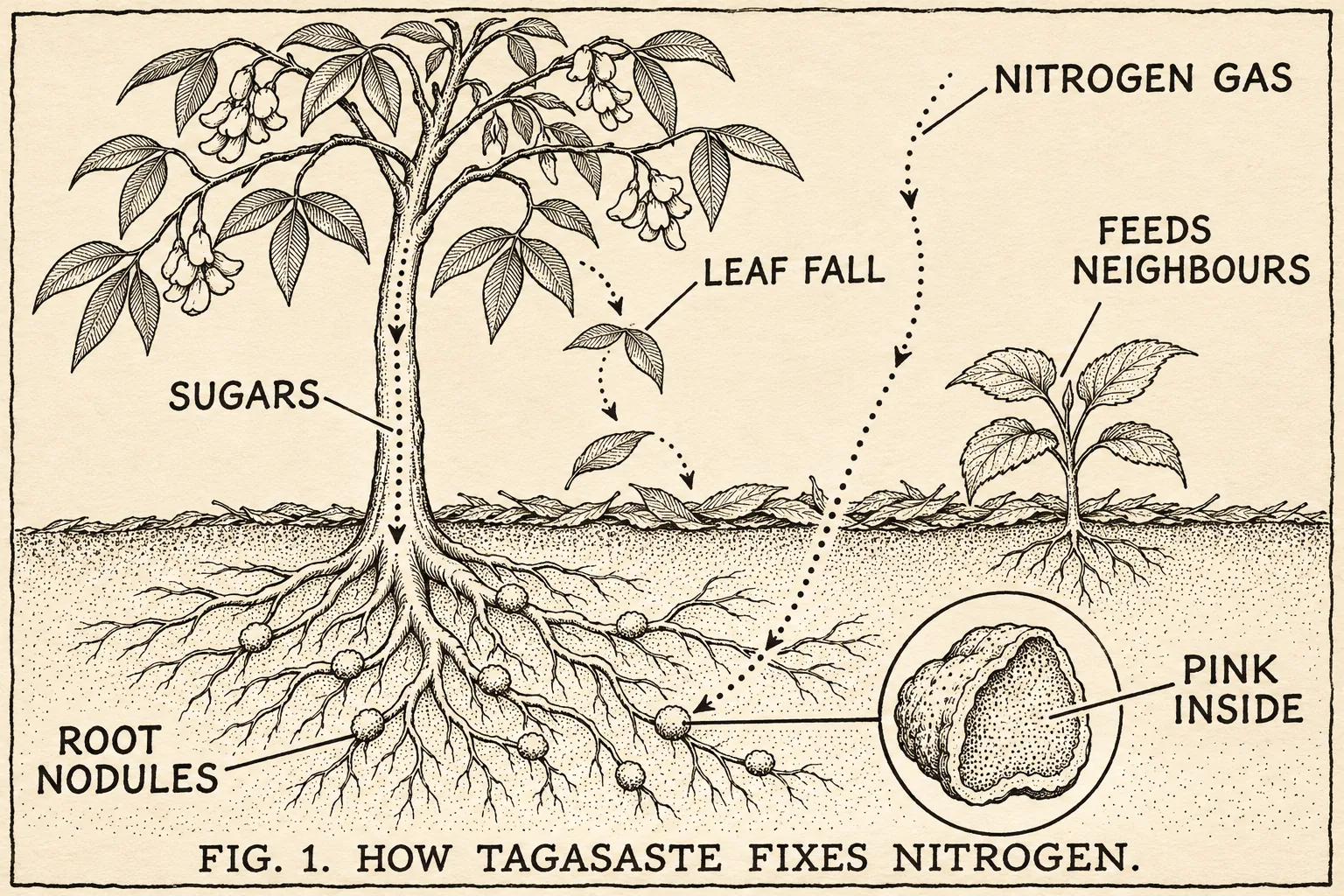
The leaf matters as much as the root. In a Manawatū trial the foliage tested at 2.6 to 3.2 percent nitrogen. Every time I prune, that leaf lands on the berm as mulch.
Growth
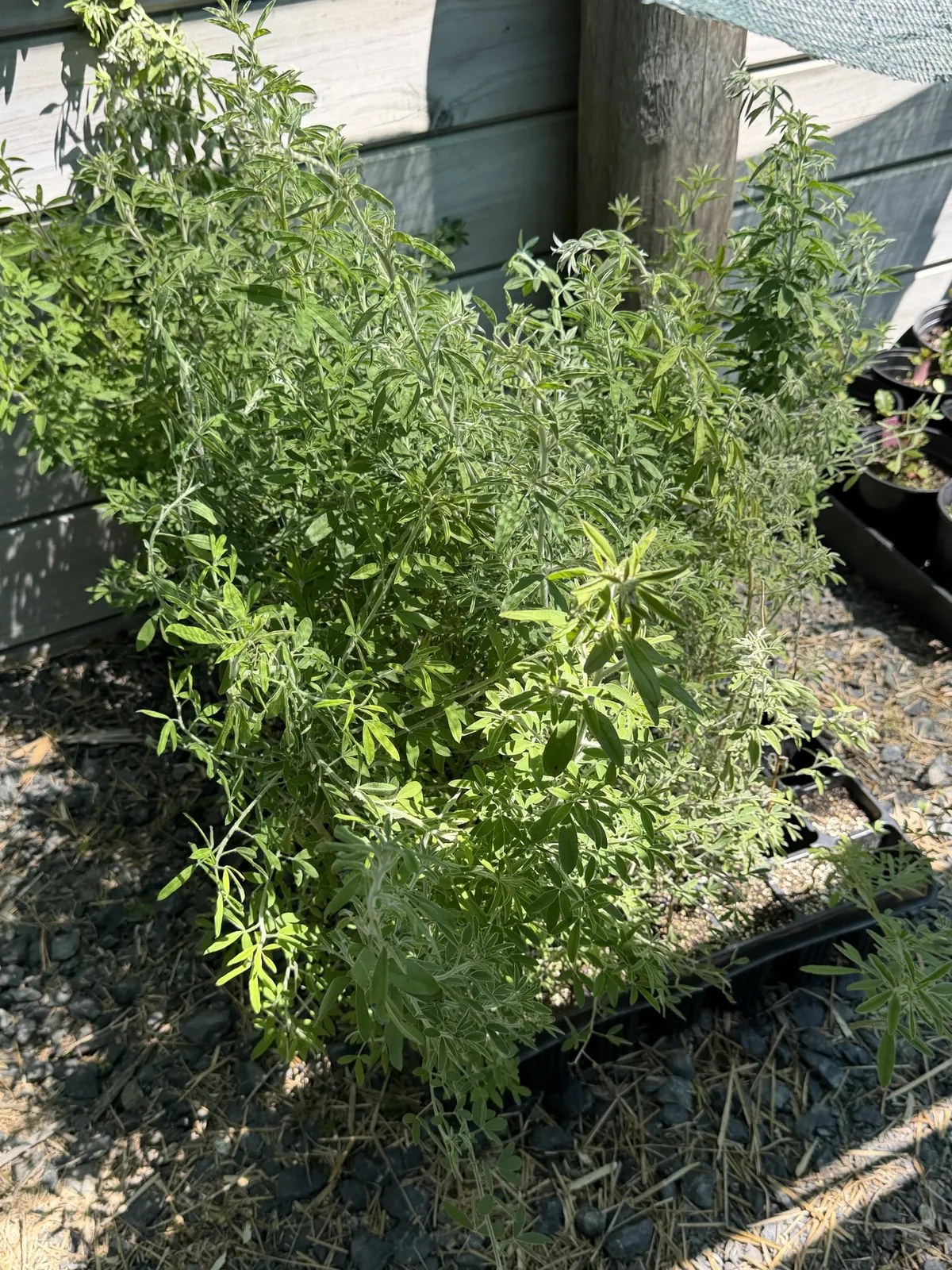
Seedlings can grow 1 to 2 m a year. The tree is evergreen, so it is working in winter when most of the garden has stopped.
Shelter in two years changes what I can plant in year three.
Wind
We are about a kilometre from the coast, and a bad north-easterly comes through at over 100 km/h.
Tagasaste grows in coastal conditions and on windy sites. Farmers plant it in shelter rows at 1 to 3 m spacing. I plant at the tight end of that range, as a hedge, so the long-term trees behind it grow up in calmer air.
Keep it trimmed. A tree left to get leggy can rock at its roots in wind.
Clay
Tagasaste hates wet feet. Where the soil stays damp it gets root rot and dies young.
My clay is on a slope that drops from 39 m above sea level to 16 m, so water does not pool on it.
It does not all leave either. Grey clay mottled with orange is clay that sits wet for part of the year. This Northland mudstone clay is wet in winter and hard and dry in summer, and it swells and shrinks as it goes from one to the other.
That is why the tagasaste goes on top of the swale berm. It is the driest position on the whole hillside, raised up out of the wet.
Will the roots open the clay up? The evidence I can find is from sand. On deep sand in Western Australia, tagasaste roots reached a water table 5 m down. Clay is a different material, and that study does not settle it.
So this part is my experiment. I planted them to break up the clay.
Bees and birds
Tagasaste flowers from late winter into spring, when very little else does. I keep bees, and they work it hard at exactly the time of year a hive is short of food.
Kererū and tūī feed on it through winter too.
Lifespan
Tagasaste lives 8 to 10 years on wetter soils and 15 or more on well-drained ground.
For a farmer that is a cost. For me it is the plan.
A pioneer that lives forever is competition. By the time my tagasaste is failing, the trees behind it will have had years of shelter, nitrogen, and leaf litter. The tagasaste comes out as firewood and mulch.
It has been done in New Zealand. On a burnt site in the Bay of Plenty, tagasaste went in as a nurse crop. Ten years on, the regenerating native shrubs had overtaken it.
Unsuitable sites
- Ground that sits wet. It will not last.
- Frost pockets. Mature trees can tolerate frosts down to about minus 9 degrees Celsius, but seedlings can be killed by frost.
- Next to native bush or a dry riverbed. The Department of Conservation lists tagasaste as a weed. The pods burst in summer and throw seed several metres, and buried seed stays alive for years.
Check your regional council's pest plant list before you put one in the ground.
Drainage
Dig a hole about 300 mm deep where you want the tree. Fill it with water.
If it is still holding water the next day, tagasaste is the wrong tree for that spot. Pick a drier position, or build the ground up into a mound or berm first.
If it drains, raise a tray of seedlings and get them in.
Mark Smith is Principal AI Counsel at Cloverbase. To discuss this article or work with me, contact me at Cloverbase.
Get each new blog post by email
One plain-text email when a new blog post is published here: a short summary and a link. We send a confirmation email first. Unsubscribe at any time.
These emails come from Meg's Cloverbase email address. We use your address only to send them. See our privacy statement.